
Recording When It Matters: School Incident Documentation
October 21, 2026 · Scott Sutton, Vice President of Operations
The hard part of a school incident often starts after it ends.
A student in crisis throws a chair in a fourth-grade classroom. The teacher walks him into the hallway, away from the other kids. That night his parent calls the superintendent and says the teacher grabbed him. The principal has never heard that version.
That scene is not rare. North Carolina schools reported 1,456 assaults on school personnel in 2024-25, and in elementary schools it was the most frequently reported crime of the year, according to the Department of Public Instruction’s annual report.
Within a week, the district’s attorney and its insurer are asking the same question: what happened, and in what order?
Most schools answer with memory. Statements get written hours later, after people have talked to each other, and they rarely agree on the sequence. That gap is where claims get decided.
What Good School Incident Documentation Looks Like
Good school incident documentation is a timestamped record made while the incident is happening, not a statement written from memory afterward. It shows when help was requested and how quickly it arrived. It is kept under a written policy that says who can view it and for how long.
The Case for a Record
A written incident report captures what someone remembers. A timestamped recording captures what happened.
That difference shows up in four kinds of disputes:
- A teacher assaulted by a student, where workers’ compensation, discipline, and sometimes criminal charges depend on the facts. Our guide on what to do when a teacher is attacked covers the reporting steps.
- An allegation against a staff member, where an accurate record can clear an innocent employee as quickly as it confirms a real problem.
- A parent complaint about how staff responded, where the district needs to show how long the response took and what was said.
- An injury claim, where the insurer wants the sequence of events and the district has only recollections.
None of this is new. Districts already run cameras in hallways and on buses, and most have decided that recording common areas is worth the cost. The classroom is different. So is the counseling office, and so is any conversation behind a closed door. Nobody wants a microphone running all day in those rooms, and districts are right to refuse one.
Triggered, Not Continuous
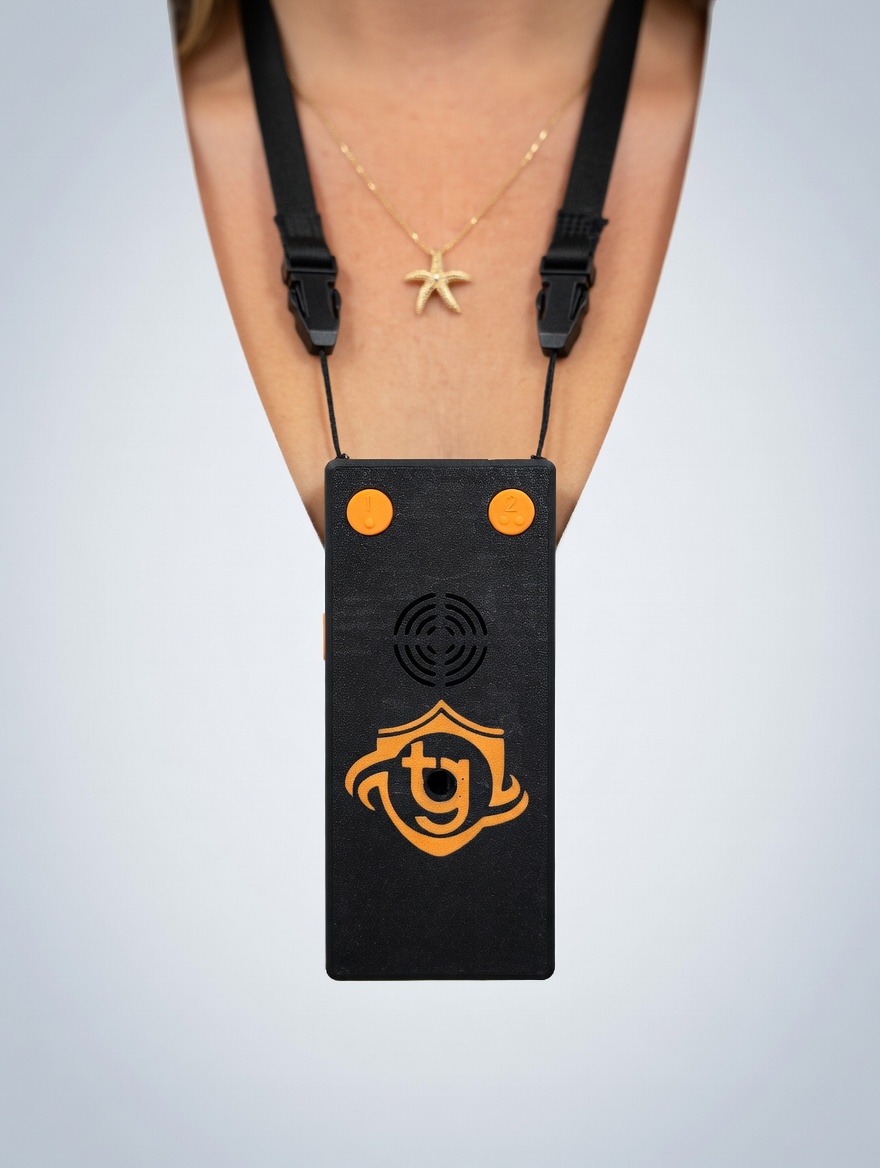
The True Guardian pendant doesn’t record all day. It captures nothing until the person wearing it presses a button.
Each school decides what the buttons do. In the standard setup, a quick press on the first button sends a silent alert and the pendant’s location to your designated responders and starts recording audio. Pressing both buttons together starts the camera, and pressing both again stops it. A school can change that to fit its policy, for example audio only, or video with audio on every alert. Nobody has to find a phone or open an app.
A teacher with a student in crisis has one hand free and about two seconds. Go back to that fourth-grade classroom. As the teacher walks the student into the hallway, she presses her pendant once. The office gets the alert, and the district has audio from that moment on. When the parent calls the superintendent that night, the district has more than her memory to go on.
Recordings are encrypted on the device and uploaded to the True Guardian Vault evidence platform, so they can’t be altered or deleted from the pendant. The Vault also logs each time a recording is opened and the device that opened it. Both support chain of custody if a recording ends up as evidence.
Narrow capture also means a narrow data set. The only recordings a district holds are from moments when a staff member decided something was wrong. Nobody ends up storing a full day of classroom audio, or answering records requests for it.
Where the Liability Sits
Districts carry risk in two directions after an incident.
The first is the claim that staff did too little: a slow response or no follow-up at all. A record that shows when the alert went out and how quickly someone arrived gives counsel facts to work with.
The second is the claim that staff did too much, or did something wrong. Here the record settles what happened, whichever way it falls.
Either way, the cost of having no record falls on the district. Insurers and attorneys price uncertainty, and an incident file built from recollections is uncertain by definition.
That uncertainty keeps getting more expensive. United Educators, which insures K-12 schools and colleges, reports that the average cost of its own general liability and educators legal liability claims nearly doubled from 2019 to 2024, with defense costs a large part of the increase. United Educators also closed more of its own claims of $2.5 million or more in 2025 than in any year in its history (Large Loss Report 2026, page 4).
Questions to Settle Before You Deploy
A recording capability needs a written policy before the first pendant goes on a lanyard. Your counsel should own these answers, not a vendor.
- Consent and notice. Audio recording laws differ by state, and some, Florida among them, require every party to a conversation to consent. Staff and families should know when the devices record.
- Student records. Audio or video that is directly related to a student and kept by the school can be an education record under FERPA. That affects who can view it and who can request a copy.
- Retention and access. Decide how long recordings are kept and who can review them.
- Staff use. Decide in writing whether recordings can be used in staff evaluation or discipline, and tell staff before rollout. Teachers will ask, and a pendant nobody trusts stays in a desk drawer.
- Restraint reporting. In North Carolina, when physical restraint of a student causes an observable injury, the principal must notify the parent promptly and provide a written incident report within 30 days covering the time, location, duration, and what led up to it (G.S. 115C-391.1). A recording made in the moment gives that report something firmer than recollection.
- Training. Staff need to know what each button does and doesn’t do, so nobody presses one expecting a result it can’t deliver.
True Guardian is a safety technology provider and doesn’t give legal advice. Your district counsel and insurer should review the policy that governs the recordings.
What to Ask Any Vendor
If you’re comparing incident documentation tools, start with these questions:
- Does it record only when someone triggers it, or all the time?
- Can you set what each button records to match your own policy?
- Where are recordings stored, can anyone alter them, and who controls access?
The answers tell you whether you’re buying a record you can use or a data problem you’ll have to manage.
See It Work
To see a single press turn into an alert on the console and on staff phones, request a demo and we’ll set up a time.